
1 Comment
[BOOK REVIEW by ZEENA] Today I received a review copy of a new German book I'm featured in: 'Mythos Wewelsburg: Fakten und Legenden' (The Wewelsburg Myth: Facts and Legends) – sent directly from the Kreismusum Wewelsburg. The authors, Daniela Siepe and Kirsten John-Stucke provide an excellent historical overview, and leave no stone unturned, in exploring all of the legends and realities surrounding the notorious and mysterious Wewelsburg castle. For German speakers who have an interest in this strange and misunderstood edifice, its history and cultural influence, I highly recommend this volume. Comprehensively researched with detailed notes and historical context, this volume includes so many obscure facts and references that even those well versed in the Wewelsburg legend would be surprised to learn yet more. 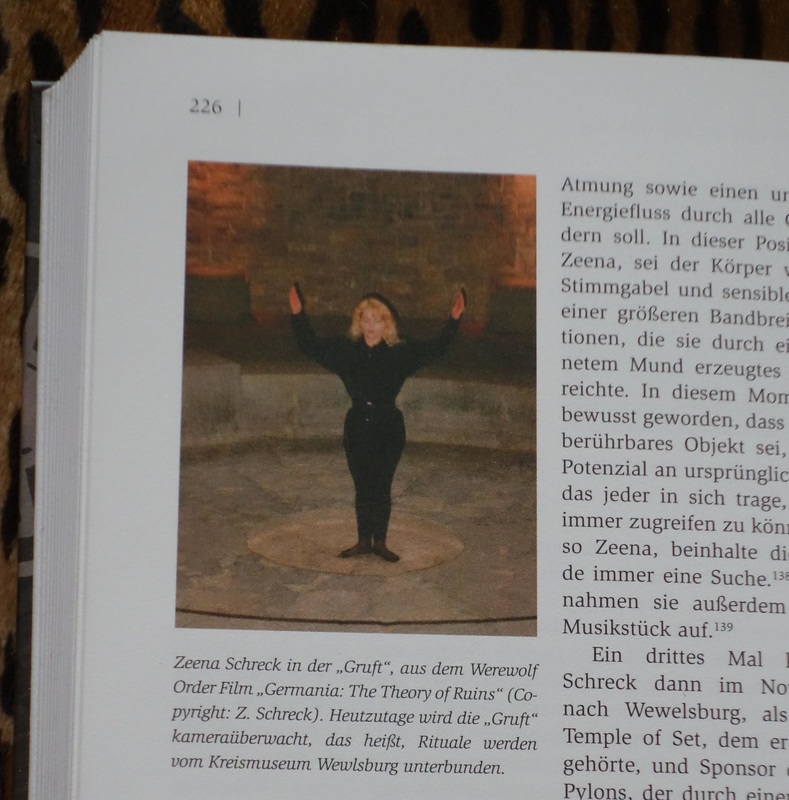 Zeena in 'Mythos Wewelsburg: Fakten und Legenden' von Kirsten John-Stucke (Autor), Daniela Siepe (Autor) For those who are not familiar with the Wewelsburg, it is a 9th century German castle that first came to world-wide attention as the “Grail Castle” of the Nazi SS. Purported to be a mystical location chosen personally by Heinrich Himmler (Reichsführer-SS), it was to become an SS leadership school and the headquarters for what Himmler believed would be a German equivalent of the Arthurian 'Nights of the Round Table,' or the stage for a living Parsifal epic. Following the end of WWII, countless legends arose surrounding this edifice, many having to do with secret cult rites and the structure having a supernatural energy, comparable to Externsteine or Stonehenge. Such legends sparked the imaginations of many authors, filmmakers, musicians, artists, political extremists, UFO fanatics, conspiracy theorists and occultists. At a time in my life when I was questioning the inconsistencies of the philosophical and religious framework within which I was raised, I began my own ardent spiritual quest. I needed to find the roots of, and truth behind, many of the figures, legends, and nomenclature which my father misappropriated for his newly created pseudo-religion. So, in 1992, I organized a personal pilgrimage throughout Germany to many sacred sites which I'd learned of early in life. I documented my journey along the way in a video-poem entitled Germania: The Theory of Ruins. One of the target sites of my journey was the Wewelsburg, where I conducted a private ceremony and oracular magical Working. The purpose of the rite was to attain insight into the reason this castle was so strongly associated with the Grail Quest, and to learn what a 'Grail Quest,' – or more specifically, what The Grail – truly is. Slipping through the bars of the iron gate to the legendary crypt, I was prepared to take on this heavy philosophical question in a spontaneous meditation. Author Daniela Siepe summarized our in-person conversation about this private magical ritual in 'Mythos Wewelsburg: Fakten und Legenden.'. I share with you the email follow-up to our in-person interview; the information in my message was incorporated into the book: Sent: Tuesday, July 23, 2013 5:21 PM Subject: Re: Grail Ritual Dear Daniela~ About the Grail ritual itself: You mentioned some points which I think might have come from things Nikolas talked about during our interview, as well as combining it with your thoughts on our EP "Bring Me the Head of Geraldo Rivera" (Lucifer's Court track). I can clarify some of that. During our interview, it was Nikolas who mentioned his interest in the legend of the Grail being the Emerald that fell from the crown of Lucifer during the battle with Michael and the angels. That was the connecting thread to Otto Rahn. But this was not my reason or point of interest in wanting to find "What Is the Grail" during my Wewelsburg working. Our use of the title Lucifer's Court on our recording occurred while we were still representing satanism (I was still the Church of Satan's High Priestess and spokesperson) and using it on that recording reflected where we were at that point in time. But that was three years before my Wewelsburg working. By the time we broke with the Church of Satan (in 1990) and began exploring more deeply into these references and figures, I realized that I was really more drawn to the same ancient legends which inspired the personalities we were researching while living in Vienna. All my life I've been driven by such things as fairy tales, sagas, mythology, folk legends, etc. Therefore it wasn't the humans involved in these various Teutonic occult orders and societies that interested me. What interested me was the same eternal phenomena which those people also explored. It wasn't long into our research of these 19th century European occult figures (Rahn, von List, Sebbotendorf, Weistor/Wiligut, von Liebenfels etc.) that I found the same reactionary, misogynistic and fundamentally subjective fantasy role-playing (albeit on a more intellectual level) as was with the occult world of satanism I'd just left. So, metaphorically speaking, if a house of cards is built on a weak foundation of sand, how valid can one regard the entire philosophies of such people? It was clear that, despite their interest in ancient legends, they were missing a big piece of the puzzle in their mystical portrayals and projections. Only when I made my first pilgrimages to the same mystical locations that were to hold such significance to these men, did I experience first-hand that visceral, intuitive feeling that they were "missing something". But I, myself, didn't yet know exactly what the "Something" was. Hence, my ritual at Wewelsburg and the documentation of many of the other places I and Nikolas made spiritual pilgrimages to in Germany and Austria in our quest for deeper answers. So when I performed the ritual at Wewelsburg, for me, it had nothing to do with the Emerald from Lucifer's Crown. You asked, "So, during your Grail ritual you were standing in the middle of the Crypt with your arms raised high. – Was this a symbolic gesture – such as the sign of the Ka? Or just a gesture which enabled you to take a deep breath?" The position was mostly for the following two reasons: 1. To become the grail, from which I was summoning answers, I needed to take the form of the grail as we know it, in a chalice-like shape (i.e., sympathetic magic, for example if you wish to know the mystery of the Sphinx, it helps to take the position of and embody that energy). 2. The body in this position/asana becomes like a musical tuning fork and is more sensitive to a wider range of subtle to greater vibrations. I had been practicing tantra for two years by that time. So I was sensitive to how the body should be held to promote energy flow for certain purposes. When you begin in this position you raise your head upwards and slowly bring it down to find the proper alignment with the spine. This enables the best, unblocked flow of energy rising upwards through all the chakras, through the central channel and out the top of the head. It also promotes even, smooth breath flow. In order to open yourself up for the answers you seek, it's very important to clear everything out of your head and have even energy flow throughout your body. You asked, "Is it correct to say that you made a humming sound (German: Summen)? And then you sensed the vibrations of the sound in your chest – while you focused (sich konzentrieren auf, meditieren) on the question “What is the grail?” " That's correct. The sound must be with the mouth open (not closed as in a hum). The particular syllable sound I made helps to clear the chakras but must be done with the mouth open. There is only one part at the end where the mouth closes to finish the mantra. The sensations, or vibrations, felt were throughout the body, not only the chest. The feeling began in the heart area and gradually spread ever outwards throughout the whole body. A very open, wide and expansive feeling. Secondly, while I'm opening myself up as I'm standing in that central spot, it's important to not think anything. The purpose for the working, "What is the Grail", is well established in focused attention directly before beginning the ritual. Once in the ritual, that thought must be dropped and no thought can enter but rather one should be very aware of what is experienced, without expectations. Using this method, the mind will be best prepared to receive signs and answers. The innate wisdom of the mind must not be forced, steered, clouded or manipulated into any predictable, or accidental, direction by the subjective wishes, interests or preferences of the individual's personality. You asked, "In this moment you realized that the grail is no tangible object, but a part of a human being himself. You cannot look for the Grail on the outside, you have to become the grail yourself (meaning you have to feel your own strength?, rely on your spiritual side which has access to a primordial wisdom??)" Yes, this is all correct as it happened (in a brief description). To make the wording more precise, I'd say it like this: "In this moment you realized that the grail is no tangible object, but a part of a human being himself. You cannot look for the Grail on the outside, you have to become the grail yourself (meaning you have to awaken to your spiritual side which has access to your primordial wisdom." We all have this potential, but don't always know how to use it or access it. This is why the legend of the Grail is always a quest, whether interpreted or experienced as the spiritual inner quest or written about and described in stories and legends as an outer physical quest. They are two levels of understanding, one esoteric (feminine-based and directly receiving the wisdom, i.e., left-hand path in practice), the other exoteric (male-based and documenting the wisdom, i.e., right-hand path in practice). When I use these terms left-hand path and right-hand path it should be clarified that it is in the authentic tantric meaning - not the Western occult definition. I hope this helps to give a little more detail to that experience. I'd be happy to talk with you by phone or Skype if there's anything else you'd like to ask or clarify. Wishing you the best of Life, Strength, Health and Happiness! Zeena [END] More information on Wewelsburg or 'Mythos Wewelsburg: Fakten und Legenden' 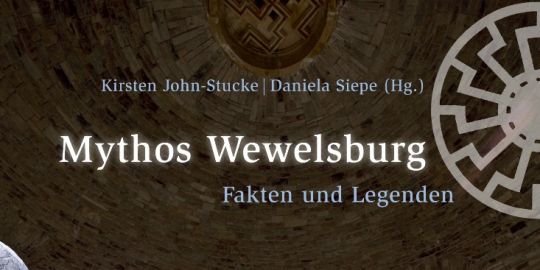 Read the full Heathen Harvest article at: http://heathenharvest.org/2015/04/18/zeena-schreck-performs-a-typhonian-tantric-ritual-soundscape-at-the-egyptian-museum-leipzig/  Review of Zeena's New Art Blog in Korean Pop Starz [ KpopStarz ] International Online Magazine30/4/2015 "The Berlin-based interdisciplinary artist, who goes by the single name Zeena, is a practicing Tibetan Buddhist yogini in the Drikung, Karma Kagyu and Nyingma lineages. She practiced and taught magic and meditation for over 30 years. Zeena is the Hemet-neter Tepi Seth of the Sethian Liberation Movement. Biographical info about Zeena can be found at Daily Offbeat." Read the whole review here: http://www.kpopstarz.com/articles/183814/20150315/zeena-schreck.htm  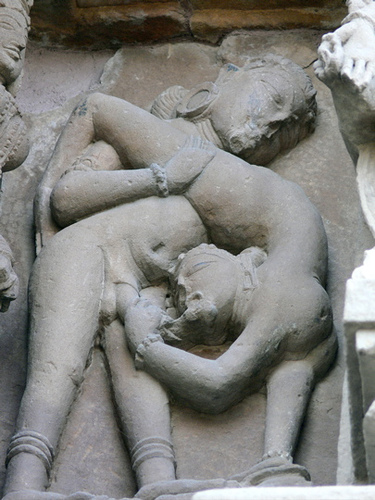 Khajuraho Temple, India Journalist Tony Sokol asks Zeena about the role of cunnilingus in magical alchemy and Eastern tantric practices for his review of the popular US TV show Salem: Book of Shadows Below, we share with you the complete, unedited quotes she gave him, from her book Demons of the Flesh. [Note: The phrase Feminine Daemonic was first coined by Zeena and Nikolas Schreck in Demons of the Flesh. "Daemonic" in this context does not mean “like a demon” but rather uses the classical greek spelling and definition to mean “spirit,” hence the 'feminine principle' or 'feminine spirit.'] Vedic left-hand path Tantrikas place great emphasis on the vaginal
A heartfelt thanks goes out today to my dear artist friend Frank Haines, who sent me his latest book, aptly titled, Frank Exchanges.

Frank organized the 2013 New York performance, “Zeena Schreck, Live from the Eye of the Storm.” Over the course of our lifetimes, Frank and I have worked, lived and loved in many of the same cities - San Francisco, Vienna and Berlin - but it wasn't until 2012 when our paths finally crossed and we began plans to collaborate on various art projects.
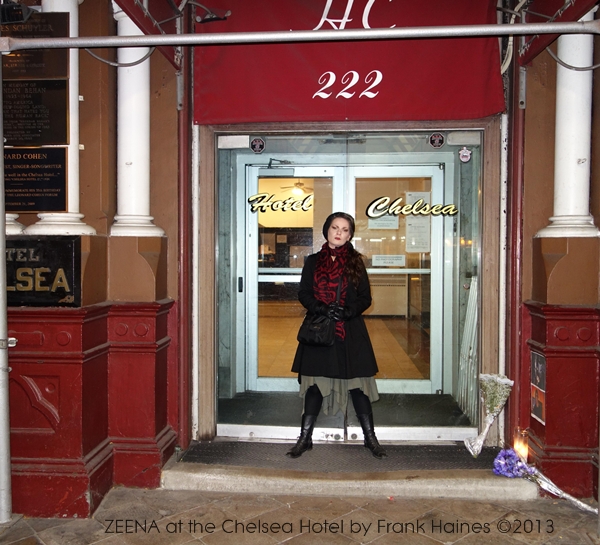
Frank Exchanges is a labor of love spotlighting twenty-six artists who have traveled through Frank's life at various times. I had the privilege of meeting many of these talented and hard-working artists as a result of my collaboration with Frank for our New York performance. So it's wonderful to learn more about this community of creators and creatrixes in this volume.
Frank is inspired by and works with artists who understand and embody the integration of spirituality, magic and the creative process. He also has an appreciation and understanding of the feminine energy central to creativity. This could be because he's been nurtured and mentored by many female artists, including his two sisters and his life's partner, Jackie Klempay. It could also be because he really digs feminine mystical artists. Conversations with Frank are often peppered with references to female artists who inspire him. So it's not surprising that the introduction to his book explains the genesis of Frank Exchanges, as related to two female artists and how the “direct interview form, where the content reflects a conversation” shaped his desire to publish his exchanges with artists he knows: When I look at a Loise Nevelson sculpture I think about the way she described eating raisins. She would not eat raisins by the bunch but singly and selectively. 'When I put a raisin in my mouth I know what I'm doing'. This single statement expresses a mindfulness about living in the world that I see reflected in her work.
[...]
“Eliza Swann interviewed me for Arthur magazine in 2011. I loved the conversation that resulted from the meeting of our minds. Inspired by these results, I wanted to document many of the ideas that have been shaped through conversations with close friends of mine.” 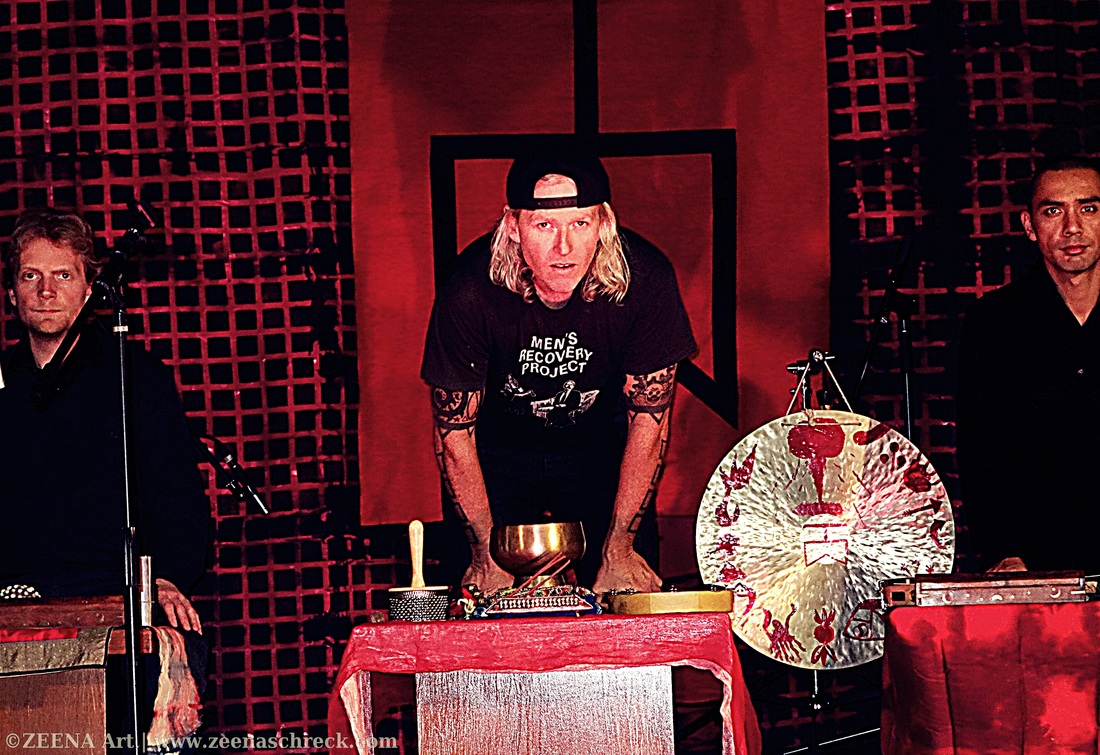
Anders Hermund, Frank Haines and Hisham Akira Bharoocha at sound & light check for Performa-13 biennial. Photo by Zeena
From that launching point, Frank manifests Frank Exchanges. A collection of essay-interviews that reveal complex philosophical and religio-magical perspectives from artists who have experienced struggle, love, pain, poverty, doubt, loss, euphoria and all of the usual challenges artists face in a society which devalues visionary thought. It offers a glimpse into the minds of ambassadors from another state of consciousness. In a strictly materialistic culture, both art and spirituality are often viewed by society as worthless, when they don't contribute to economic and industrial productivity. So it's refreshing to see artists intelligently interviewed by one of their own, rather than being asked inane questions by someone who can't relate to the creative spirit!
~Zeena |